
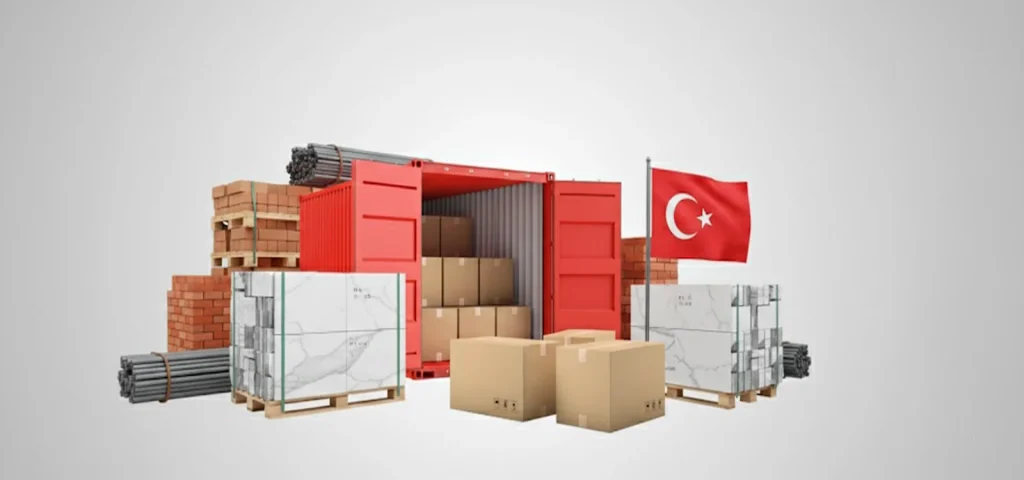
Are you a contractor or trader seeking European-quality materials at competitive prices? The construction sector in the Gulf—especially in Saudi Arabia and the UAE—is booming like never before. Everyone is looking for a better alternative to China, and Turkey has emerged as a major player, offering finishing and construction materials that rival Italian and Spanish products, but at lower cost and with closer proximity—cutting shipping times in half.
In this strategic guide from Turk Mersal, we share our expertise in shipping heavy construction materials, guide you to key industrial cities, and show you how to ship marble and steel without losses.
Why Turkish Construction Materials Are the Top Choice in 2026
Before discussing the “how,” let’s clarify the “why” behind major developers turning to Turkey:
- Quality Standards:
Turkish construction materials comply with European CE standards and Saudi SASO standards, making them easily accepted in Gulf markets. - Geographical Proximity:
Sea shipping from Turkey to the Gulf takes 20–25 days, compared to 45 days from China. - Product Variety:
From rebar in İskenderun, to premium marble in Afyon, to ceramics in Eskişehir—Turkey offers it all.
Construction Materials Import Map (Key Products & Cities)
Each Turkish city has its specialization—here’s how to source smart:
1. Finishing and Interior Materials
- Marble & Granite:
Turkey is a global leader in marble exports. Afyon and Muğla are known for top-tier quality. - Ceramics & Porcelain:
Bilecik and Eskişehir boast factories rivaling Spanish design. - Doors & Windows:
Wooden, armored, and PVC windows with high insulation—found in Istanbul and Konya.
2. Structural Building Materials
- Rebar & Steel:
Major factories are located in İskenderun (southern Turkey), enabling low-cost sea shipping. - Cement & Insulation:
Widely available and highly competitive in price.
3. Plumbing & Electrical Fittings
- Bathroom sets, mixers, electrical cables — mainly from Istanbul and Bursa.
Step-by-Step: How to Import Successfully
Step 1: Supplier Search & Verification
Don’t rely on online searches alone. Visit major exhibitions like Yapı Fuarı in Istanbul.
Turk Mersal Tip:
Before signing contracts, request actual samples and verify factory certifications (e.g., ISO, Mill Test Certificates for steel).
Step 2: Contracting & Document Preparation (Mandatory List)
Importing construction materials requires precise paperwork to avoid customs rejection:
- Commercial Invoice (3 certified copies):
Must specify pricing terms (FOB or EXW). - Certificate of Origin:
Confirms the goods are Turkish (used for duty exemptions). - Packing List:
Detailed breakdown (pallet count, net/gross weight). - Conformity Certificates (SASO/COC):
Must be issued via the SABER platform for Saudi and Gulf countries before shipment.
Step 3: Shipping & Logistics (Our Specialty at Turk Mersal)
Shipping construction materials differs from shipping apparel—it’s all about heavy loads.
- 20-ft Containers (for heavy goods):
Marble and ceramics are often shipped in 20-ft containers due to weight limits (Heavy Weight Density). - Open-Top Containers:
Ideal for long pipes or machinery that can’t fit through standard doors. - Flatbed Trucks:
Best for shipping steel and cement to neighboring countries or Europe.
Key Challenges in Shipping Construction Materials (and Our Solutions)
Shipping building materials is not just point-A to point-B. It’s an engineering operation. Here are 4 top challenges and how we solve them at Turk Mersal:
1. Dead Weight & Load Distribution
Marble and steel are extremely dense. Overloading can damage container floors or exceed port weight limits.
Our Engineering Fix:
We use load distribution software to calculate axle loads. We load marble/steel in 20-ft containers, reinforce container floors with wooden supports, and ensure compliance with road/port limits.
2. Lashing & Securing to Prevent Damage
Ocean movement can break marble slabs or dislodge steel coils—causing container disasters.
Our Safety Techniques:
- Dunnage Bags: Fill empty spaces, absorb shocks.
- A-Frames: Secure large marble slabs upright at safe angles.
- Heavy-Duty Straps: Anchor goods to container walls and prevent lateral movement.
3. Moisture & Steel Rust (Container Rain)
Temperature shifts cause condensation, leading to rust or damage to gypsum/cement bags.
Our Moisture Control:
- High-efficiency desiccants inside containers.
- Shrink wrap for sensitive goods—full air barrier.
4. Quantity Loss (Shortage)
A 3–5% breakage in ceramic shipments is often considered “normal”—but it’s still a loss.
Our Preventive Measures:
We request free or cost-price spare quantity from factories. We also inspect packaging to ensure 5-ply cartons for stack pressure resistance.
Why Choose Turk Mersal for Your Construction Imports?
We’re more than a “carrier”—we are your Project Logistics Manager in Turkey:
1. Multi-Vendor Consolidation Service
Your project may need tiles from Factory A, mixers from Factory B, and cables from Factory C.
Instead of shipping 3 partial containers (expensive!), we consolidate all items in our warehouse and load them in one engineered container—saving you up to 40% in shipping and clearance costs.
2. Technical Quality Control (QC)
Our engineers don’t just count cartons—they inspect product specs:
- Marble: Color consistency, micro-crack inspection.
- Steel: Diameter check (caliper test), verify Mill Test Certificate against engraved numbers.
3. Expert Documentation Handling
Construction materials require highly specific documents (e.g., ISO 9001, CE, SASO).
Our legal team reviews all paperwork before shipping to avoid customs delays or rejections due to non-compliance.
4. Heavy Project Cargo Solutions
Importing tower cranes or oversized steel structures?
We handle Out-of-Gauge (OOG) cargo and full vessel chartering for mega-projects.
Frequently Asked Questions (FAQ)
Q: What’s the difference between EXW and FOB when buying construction materials?
A:
- EXW (Ex-Works): You pick up goods from the factory. You handle local transport and Turkish customs clearance. Recommended if buying from multiple factories.
- FOB (Free On Board): The factory handles transport and clearance until the goods are on board the vessel. Easier for you, but check for hidden internal transport fees.
Q: Are there anti-dumping duties on Turkish ceramics or steel?
A:
Possibly. Some countries impose anti-dumping duties to protect local industries.
At Turk Mersal, we review the updated customs tariff for your country (Saudi Arabia, Egypt, Europe) and notify you of any extra fees for your feasibility study.
Q: How are extra-long items (e.g., 12-meter pipes) shipped?
A:
Standard containers (20/40 ft) can’t fit such lengths easily. We use:
- Open-Top Containers: Loaded from above by crane.
- Flat Rack Containers: For irregular or oversized items.
- Break Bulk Shipping: For very large volumes—cargo placed directly in ship holds.
Q: Can I ship chemical construction materials (e.g., paints, adhesives)?
A:
Yes, but they’re usually classified as DG Cargo (Dangerous Goods). They require:
- Special packaging
- MSDS (Material Safety Data Sheet)
We handle these steps fully.
Q: What’s the production lead time for construction material orders in Turkey?
A:
Depends on factory and quantity:
- Stock items: 3–7 days
- Custom orders: 15–45 days
Pro tip: Coordinate with us one week before completion to reserve containers and avoid delays.
Q: Can you provide samples before placing a full order?
A:
Absolutely. We collect samples (tiles, steel pieces, accessories) from multiple factories and send them in one express air shipment (via DHL/FedEx) for your review and approval before financial commitment.
Do you have a real estate project and need building materials?
Don’t risk it with amateurs. Let us handle shipping and clearance—you focus on construction.
📄 [Download the 2026 Construction Import Checklist]
🏗️ [Request a Quote for Shipping Building Materials Now]